
DIY French Drains: The Technical Guide to Doing It Right (And Why Most Fail)
- Preston Robinson
- Dec 28, 2025
- 3 min read

Updated: Mar 27

Can I install a French drain myself?
The honest answer is yes, physically, you can install a French drain yourself—but you should know exactly what you are signing up for. While YouTube tutorials make it look like a weekend project, the "sweat equity" calculation is brutal. You will be moving tons of heavy, often compacted clay soil and hauling wheelbarrows of gravel by hand. The biggest risk isn't the physical labor, though; it's the precision. If you dig for three days and get the slope wrong by even an inch, the water won't move, and you will have created a "slushy moat" in your yard rather than a drainage system. Professionals use laser grading technology to ensure perfection, whereas DIYers often rely on "eyeballing" it. If you decide to DIY, be prepared to be precise—because digging it up to fix it is twice the work.
How deep should a French drain be for a yard?
For a standard residential system in our area, a French drain should typically be 18 to 24 inches deep. This depth is crucial for two reasons:
It must be deep enough to lower the subsurface water table, not just catch surface rain.
It leaves room for about 4–6 inches of topsoil on top, allowing your grass to grow back seamlessly over the trench.
We use the "Burrito Method" for installation. This means lining the entire trench with heavy-duty non-woven geotextile fabric (not cheap weed barrier!) before placing the pipe and gravel. This fabric "taco shell" prevents soil from washing into the gravel and clogging the system over time.

What kind of pipe is best for yard drainage? (PVC vs. Corrugated)
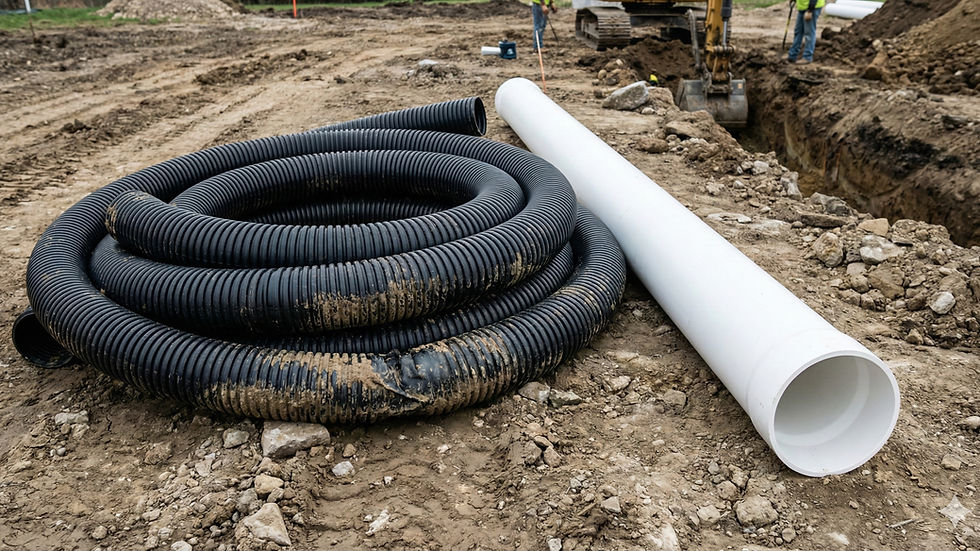
You will often see two main options at the hardware store: the black, flexible "corrugated" pipe and the white, rigid PVC.
Corrugated Pipe: It is cheaper and flexible, but it has major downsides. It crushes easily under weight, and the internal ridges trap debris, making it almost impossible to clean out with a plumber's snake later.
PVC (SDR-35 or Triple Wall): This pipe has a smooth interior, which allows water to flow faster and flush out debris. It is extremely durable and can be pressure-washed or snaked if it ever needs maintenance.
Our Verdict: We always recommend smooth-wall PVC. It costs a little more upfront but ensures a system that lasts for decades rather than years.
What is the best gravel size for French drains?
The industry standard for a high-functioning French drain is clean, washed 3/4-inch to 1-inch drainage stone (often referred to as #57 stone).
The most critical mistake to avoid is using "crusher run" or any gravel that contains rock dust or sand. Once that dust gets wet, it turns into a concrete-like sludge that clogs your filter fabric and stops water from entering the pipe. We also prefer using round river rock when possible, as the smooth edges create better air pockets for water flow compared to jagged, crushed gravel.

How much slope does a French drain need to work?
Water doesn't move without gravity. The golden rule for drainage is a minimum of 1% slope. This means for every 10 feet of trench length, the pipe needs to drop at least 1 inch. This sounds simple, but maintaining that consistent drop over 100 feet of uneven ground is incredibly difficult by hand. If your trench has "bellies"—low spots where the pipe dips down and then goes back up—water will sit stagnant in those dips, breeding mosquitoes and collecting silt. This is why we use a Laser Level on every job. It guarantees a continuous, perfect slope so water never stalls in the pipe.

Can a French drain end underground?
This is a hard NO. A French drain is a transportation system; if the pipe just "ends" in the dirt, the water has nowhere to go, and the system will back up immediately during the first rain.
The water must have an exit strategy. The three most common solutions are:
Daylighting: Running the pipe until the slope of your yard allows it to pop out of a hillside (letting gravity take over).
Pop-Up Emitter: A valve installed flush with your lawn that "pops up" when water pressure builds, releasing the water safely onto a lower part of the property or the street.
Dry Well: If you have absolutely no slope, the pipe can feed into a large, buried gravel pit (dry well) that allows water to slowly leach back into the deeper earth.
Still have questions about your yard?
Check our Drainage Knowledge Base: [https://www.gardenpicasso.com/faqs]
See our Pricing & Process: [https://www.gardenpicasso.com/services]
Ready to fix the mud? [https://www.gardenpicasso.com/contact] to book a consultation.


Comments